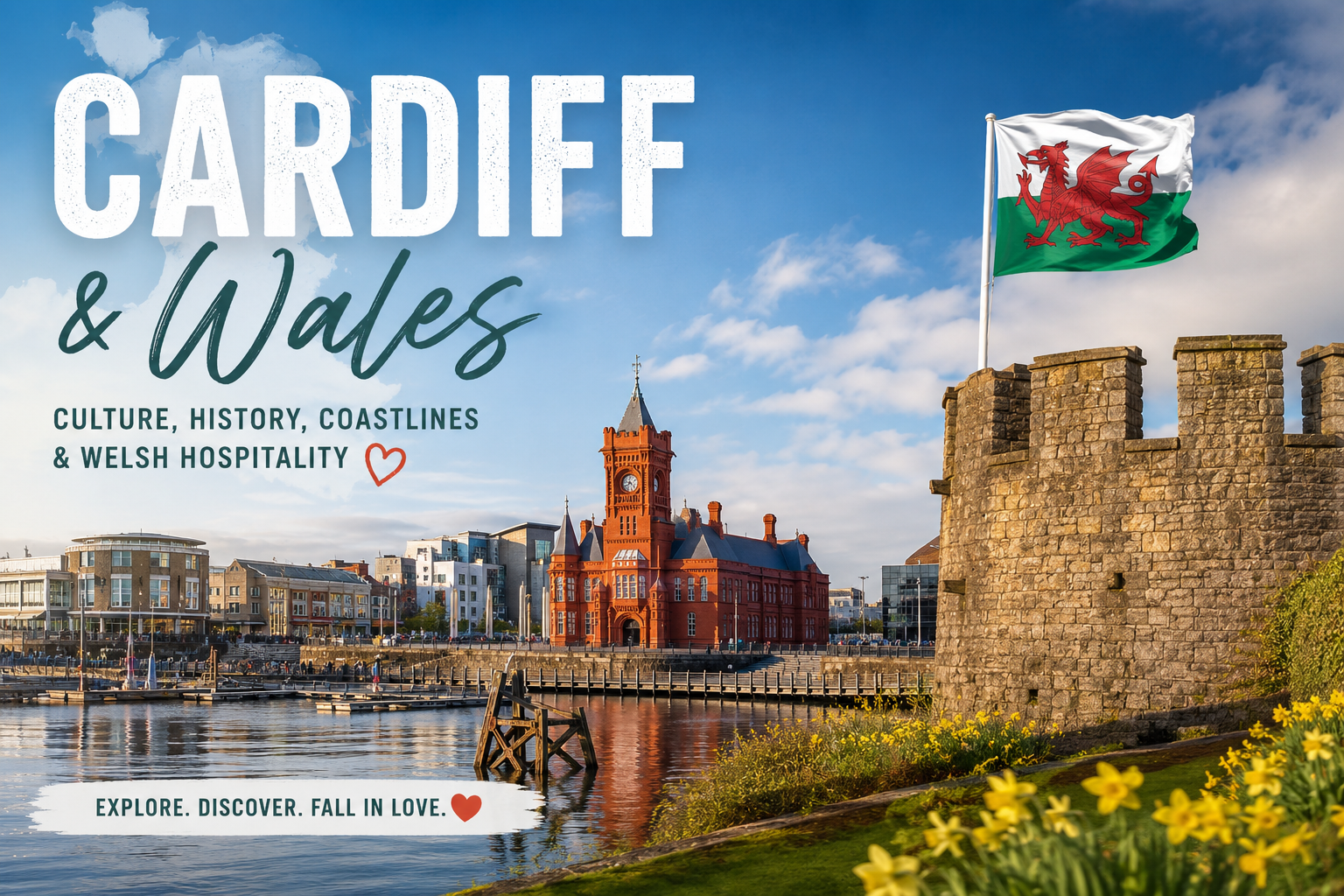
Easy Escapes to Castles, Beaches, and Mountains
One of the greatest advantages of the Welsh capital is its proximity to diverse landscapes. Within an hour, you can transition from the rugged peaks of a National Park to the golden sands of a secluded beach.
At Best UK Tours, we’ve spent years perfecting tours around Wales. While we know that the “big hitters” are essential, it’s the off-the-beaten-path detours that turn holidays into lifelong memories.
Escape the city for a few hours (or a full day) with these unmissable escapes.
Caerphilly Castle
Just a short drive north of Cardiff lies Caerphilly Castle, a 13th-century stone beast that remains the second-largest castle in Britain (bested only by Windsor Castle). It is constructed in a medieval “concentric” design, walls within walls surrounded by vast, man-made lakes. Forget the Leaning Tower of Pisa; Caerphilly has the Leaning Tower of Wales!
Following the English Civil War, an attempt was made to destroy the castle with gunpowder. One of the towers split but didn’t collapse; it simply leaned outward at a precarious angle. It’s a favourite spot for Best UK Tours guests to snap “holding up the tower” photos.
Tip: Look out for the “Green Lady,” the castle’s resident ghost. Legend says she is Princess Alice, who died of a broken heart.
St Fagans National Museum of History
Located on the western fringe of Cardiff, St Fagans is consistently voted Wales’s favourite attraction. This isn’t a typical museum where you gaze at historic artefacts sealed in glass cases. Instead, it is a 100-acre open-air site. Over forty original buildings from different historical periods have been dismantled, moved, and re-erected.
Walk from a 12th-century church into a 1940s “prefab” house, then visit a Victorian schoolhouse where the teachers still stay in character.
Other buildings to see include:
- The Neon Church: St Teilo’s Church was painstakingly reconstructed to show what medieval churches actually looked like. Not the grey-stone decor we see today, but rather exploding with vibrant murals.
- The Bakery: Don’t miss the working bakehouse where you can buy traditional Bara Brith (fruit bread) still warm from the oven.
Castell Coch
Perched on a steep, wooded hillside overlooking the Taff Valley, Castell Coch is a romanticist’s dream with conical red turrets poking through the emerald canopy like something out of the Black Forest.
The castle is actually a 19th-century “fake” that’s built on the ruins of a medieval fort. It was commissioned by the 3rd Marquess of Bute as a summer retreat. The interiors are an explosion of high-Victorian madness.
- The Lady Bute’s Bedroom: Look up at the ceiling to see a circle of monkeys carved into the woodwork (a cheeky nod to the Marquess’s eccentricities.)
- The Fables Room: The drawing room walls are covered in illustrations of Aesop’s Fables, but with a slightly dark, twisted Victorian edge.
Waterfall Country
For those who want to experience the “mountains” without the intense climb of Pen y Fan, Waterfall Country in the southern reaches of the Bannau Brycheiniog (Brecon Beacons) is the perfect alternative. In fact, this area is home to the highest concentration of waterfalls in the UK!
The unmissable experience here is the Sgwd yr Eira (Fall of Snow) waterfall. Thanks to the way the rock has eroded, you can walk directly behind the thundering curtain of water. Standing between the rock face and a wall of roaring white water is a sensory experience that no photograph can truly capture.
Big Pit National Coal Museum
To understand Wales, you must understand coal mining and its role in the country’s evolution. Big Pit is located in Blaenafon (a UNESCO World Heritage site). It is a real coal mine that operated until 1980. Now, it is a museum where the tours are led by former miners. This creates a truly immersive and authentic experience.
You are issued a hard hat and a heavy lamp battery pack before being lowered 300 feet (90 meters) into the earth in a rattling cage. In the pitch-black tunnels, the guides share firsthand stories of the “colliery life,” the camaraderie, and the dangers of the coal mining industry.
The Gower Peninsula
The Gower Peninsula was the UK’s first designated “Area of Outstanding Natural Beauty,” and for good reason. While most people head to the Mumbles, Best UK Tours also recommends Rhossili Bay with its three miles of golden sand. It is frequently voted one of the best beaches in the world.
At the far end of the bay lies Worm’s Head, a serpent-shaped tidal island.
- You can walk out to the “Worm” during a narrow two-hour window on either side of low tide. But don’t mistime it. You’ll be stranded on the island for 12 hours!
- At low tide, the skeletal remains of the Helvetia, a ship wrecked in 1887, poke out from the sand, providing a haunting backdrop for photographers.
Tintern Abbey and the “Devil’s Pulpit”
Lying in the Wye Valley on the border of Wales and England, Tintern Abbey is the most iconic ruin in the country. This Cistercian abbey was stripped of its lead roof during Henry VIII’s Dissolution of the Monasteries. As a result, it was left as a haunting, skeletal shell that inspired poets like Wordsworth and painters like Turner.
Most visitors walk around the Abbey floor and leave, but you shouldn’t miss the hike up through the woods to the Devil’s Pulpit. This limestone outcrop offers an astounding bird’s-eye view of the Abbey nestled in the valley below.
- The Legend: It is said that the Devil stood on this rock to tempt the monks below to abandon their duties.
Making the Most of Your Welsh Escape
Our private driver and bespoke Welsh tours eliminate the stress of navigating unfamiliar surroundings, tricky transportation schedules, and vehicle parking. This allows you to enjoy your trip and hear the stories that the guidebooks miss. The historic sights and landscapes surrounding Cardiff offer a profound sense of place and history that lets you walk right into it.
Best UK Tours offers bespoke day trips from Cardiff tailored to your interests. Contact us to discover the hidden secrets of the Welsh landscape.