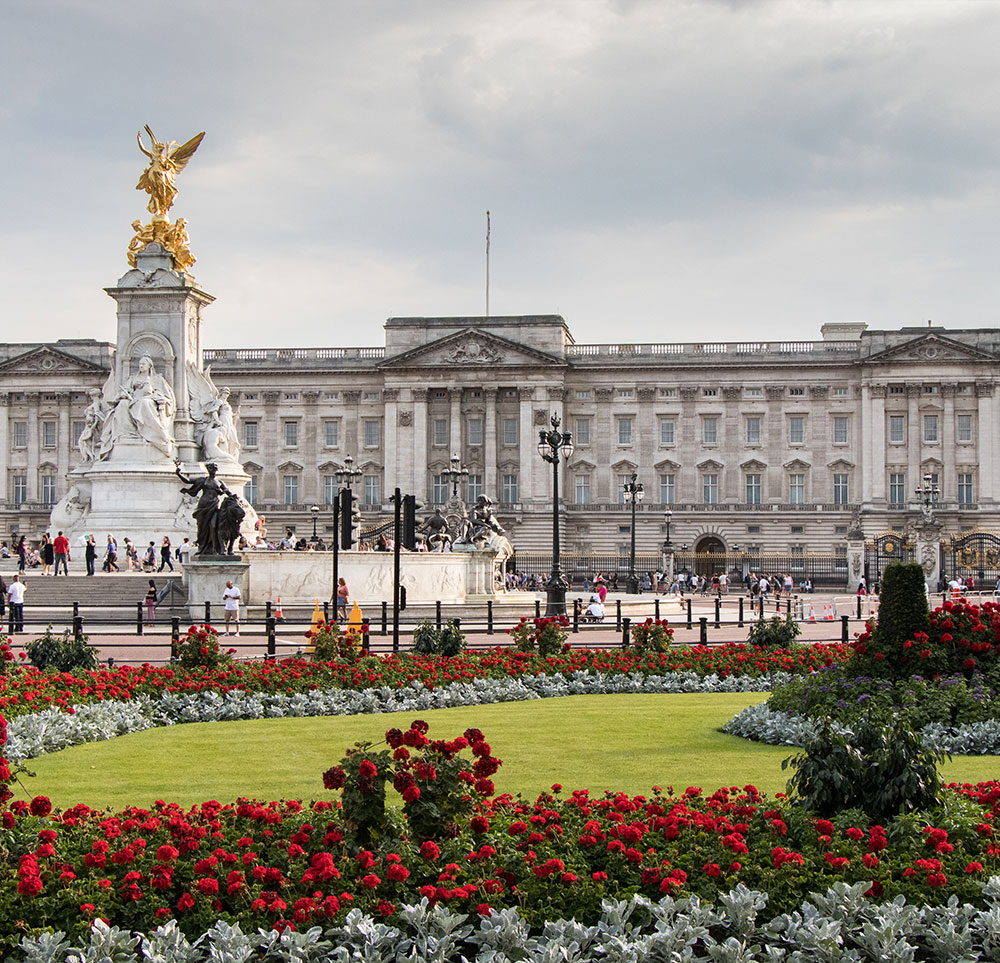
As its incredible opulence and majestic architecture would suggest, Buckingham Palace is the official London Royal residence of the British monarchy. It serves as both a working royal palace and as the ceremonial headquarters of the monarchy. It is an instantly recognizable, beloved symbol of the British Royal Family. From lavish neoclassical architecture to the King’s Guard, read on for everything you need to know before your upcoming visit to Buckingham Palace in London.
The History of Buckingham Palace
Buckingham Palace first became linked to the Royal Family in 1761 when King George III purchased the property, known at the time as Buckingham House, for his wife Queen Charlotte to use as a comfortable family home close to court at St James’s Palace. Fourteen of the couple’s fifteen children were born there. Therefore, the House quickly became known as the Queen’s House.
George IV ascended to the throne in 1820 and decided to transform Buckingham House into a palace in 1826. The facade was faced with demure Bath stone and reflected elegant, French neoclassical influences. The King’s extravagant architect John Nash added a new suite of rooms to the garden side of the building, facing west. However, after George IV’s death, the renovations were instead completed in 1834 by Lord Duncannon, First Commissioner of Works, and new architect Edward Blore.
A few years after the renovations were completed, Buckingham Palace became the official London residence of the British monarchy in 1837 when Queen Victoria began her reign. She moved to Buckingham Palace from the smaller Kensington Palace. This was due to it being a more private, larger, and generally more suitable royal residence. From this point, Buckingham Palace became a symbol of the monarchy’s power and the future of the British Royal Family. The palace also earns a place in our guide to more royal places to visit in and around London.
The Family Home Great Britain’s Monarch
Despite being the administrative hub of the Monarchy, Buckingham Palace is first and foremost the Monarch’s family home. Queen Elizabeth II gave birth to King Charles III here. Multiple christenings took place in the Palace’s Music Room including that of The King, The Princess Royal, The Duke of York, and The Prince of Wales. Many Royal Weddings have been celebrated at Buckingham Palace. For example, the Prince and Princess of Wales wed here.
As the Monarchy’s administrative headquarters and constitutional centrepiece, the Palace is very much a working building. It is home to the offices of those who support the King, Queen, and their immediate family on a daily basis. This includes the Private Secretary’s Office, the Privy Purse, and the Treasurer’s Office.
Buckingham Palace serves as the venue for many royal events and ceremonies, from celebrating achievements at Investitures to entertaining foreign Heads of State. In total, it is estimated that over 50,000 guests visit the Palace every year for a range of purposes. These include State Banquets, lunches, dinners, receptions, and Garden Parties. The King also holds weekly audiences with the Prime Minister in the Audience Room at Buckingham Palace.
Public Access and Guided Tours
On any day of the year, tourists can visit the gates of Buckingham Palace to experience its grandeur and witness the iconic Changing of the Guard ceremony. The precision and discipline of this is a true spectacle to behold. It is the sort of moment our 3 Day British Odyssey tour of London’s royal palaces is built around. Known for their iconic scarlet uniforms, black bearskin hats, and pearly white gloves, the King’s Guard is a ceremonial military unit responsible for guarding Buckingham Palace and other royal residences. Moreover, they symbolize protection and tradition within the British monarchy. Windsor has its own guard ceremony too, and our advice on visiting Windsor Castle explains when to catch it.
When it comes to exploring the inside of Buckingham Palace, despite often being in use for the official events and receptions held by The King, the State Rooms, East Wing, and Garden of Buckingham Palace are open to visitors every summer. Visitors can book to see just the East Wing, the East Wing and the State Rooms, or the State Rooms and the Garden. For the first time, guests visiting in 2025 will have the special and unique experience of entering through the Palace’s front gates. In addition, they will cross the famous Forecourt, just as guests do for official royal events.
Watching the Changing of the Guard
The Household Division publishes the schedule for the ceremony, and it is worth a look before you build a morning around it. The railings along the forecourt fill up long before anything happens, and the front row tends to go to whoever turned up first with a flask. The balcony everyone recognises from royal occasions is the one in the middle of that facade, directly above the forecourt.
If the crowd looks impenetrable, watch the march instead. The New Guard forms up at Wellington Barracks on Birdcage Walk and comes down to the Palace with its band, and afterwards the detachment for St James’s Palace heads back along The Mall. The steps of the Victoria Memorial give you height over the forecourt, while the pavements either side of The Mall give you the music and the movement at close range without the scrum.
Whether the King is at home
There is a simple way to tell, and it is flying above your head. When the monarch is in residence the Royal Standard flies from the Palace, and when he is elsewhere the Union Flag takes its place. Children tend to enjoy spotting it rather more than the adults will admit.
Getting there, and what sits within walking distance
The Palace stands at the western end of The Mall with Green Park on one side and St James’s Park on the other, and Green Park, St James’s Park and Victoria stations are all a short walk away. The Royal Mews, where the state coaches and the carriage horses are kept, has its own entrance round on Buckingham Palace Road, and it is a quieter corner of the estate than the front railings.
There is nowhere sensible to park nearby and the roads immediately around the Palace close while the ceremony is on, so we set you down close by and collect you afterwards rather than leaving you a long walk back to a car. From the forecourt you can walk the length of The Mall to Horse Guards and on to Westminster Abbey, which makes the Palace a natural first stop rather than a last one. Our private London tours thread those together, and our guide to London’s most famous landmarks will help you work out what else earns a place in the day.
Why not try one of our London Day Tours and see this wonderful building for yourself?