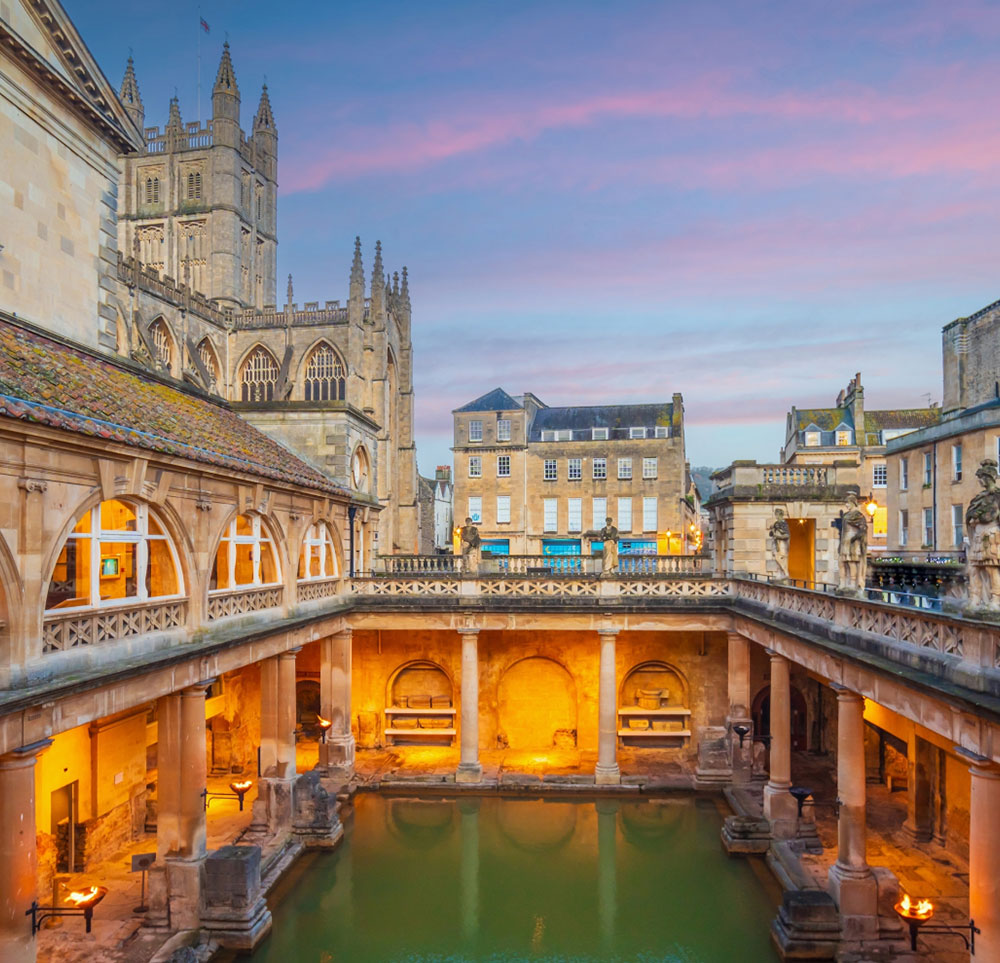
Of all the cities we take our guests to, few cast a spell quite like Bath. The city of Bath, England packs two thousand years of history into a compact, walkable centre built almost entirely from honey-coloured local stone, with a steaming Roman temple complex at its heart and sweeping Georgian crescents on its hillsides. It sits about 115 miles west of London, and the entire city holds UNESCO World Heritage status, an honour usually reserved for individual monuments rather than a whole living, working city.
In this guide we will walk you through Bath’s history and its essential sights, then cover the practical side of a visit, from getting there from London to how long to allow. Once you have read it, our round-up of ten things first-time visitors notice in Bath makes a good companion piece.
A Short History, from the Romans to Jane Austen
Bath exists because of an accident of geology. Hot mineral water rises here at around 46°C, the only place in Britain where that happens, and people have gathered around the springs for as long as anyone can trace. Local legend goes further back still, crediting the discovery to Prince Bladud, who is said to have been cured of leprosy after watching his pigs wallow in the warm mud. It is almost certainly nonsense, but Bath has never let that spoil a good story.
What is beyond doubt is that when the Romans arrived in the first century AD they built a temple and bathing complex here called Aquae Sulis, dedicated to Sulis Minerva, a diplomatic blend of the local Celtic goddess Sulis and their own Minerva. For nearly four centuries it was one of the great religious and social centres of Roman Britain. After the Romans withdrew the baths gradually collapsed and silted over, though the city never quite left the national story. Edgar, the first king of all England, was crowned here in 973, in a ceremony that set the pattern for English coronations ever since.
Bath’s second golden age arrived in the 18th century, when taking the waters became the height of fashion and polite society descended on the city every season. The social whirl was choreographed by Richard “Beau” Nash, the city’s famous master of ceremonies, who set the rules of the season right down to when the dancing had to stop. Two architects, John Wood the Elder and his son John Wood the Younger, gave the boom its shape, laying out the terraces and crescents in local Bath stone that still define the city today. Jane Austen lived here from 1801 to 1806 and set much of Northanger Abbey and Persuasion in the city; her characters flirt and promenade through streets and assembly rooms you can still walk through, largely unchanged.
The Roman Baths
The Roman Baths are the reason the city exists, and they remain its essential sight. The Great Bath still fills with steaming spring water through the original Roman plumbing, which is a remarkable thing to consider as you stand beside it. Around the pool, the museum displays the gilt bronze head of Sulis Minerva alongside the famous curse tablets, small sheets of lead on which Roman bathers scratched complaints to the goddess about stolen towels and cloaks. Some grievances, it seems, are eternal.
You cannot bathe in the Roman pools themselves, though the neighbouring Pump Room will happily serve you a glass of the warm spa water to taste. We would describe the flavour as memorable and leave it there. Allow around two hours for the site, as it rewards an unhurried visit, and note that on summer evenings the Great Bath is lit by torchlight, which is well worth planning around if your dates allow. If you would rather explore it with someone who can bring the stones to life, our private tour of Bath and the Roman Baths does exactly that.
Bath Abbey
A few steps from the baths stands Bath Abbey, on ground that has held a church since 675. The present building was begun in 1499, which makes it the last great medieval church raised in England, and its glory is the fan-vaulted ceiling, stone spread across the roof in patterns so fine they look woven rather than carved. Outside, look up at the West Front for the angels climbing ladders towards heaven, an image said to have come to Bishop Oliver King in a dream.
The abbey remains a working church, so opening hours flex around services, and its acoustics make the regular concerts something special. If your legs are willing, you can book a tower climb for a view across the rooftops that shows exactly why the Georgians were so pleased with what they had built.
The Royal Crescent and the Circus
Walk ten minutes uphill from the abbey and Georgian Bath opens out in front of you. The Circus came first, begun by John Wood the Elder in 1754 and finished by his son after his death: three curved terraces of townhouses enclosing a circular lawn, with a diameter often said to match that of Stonehenge, a monument the elder Wood had surveyed and greatly admired.
A short stroll along Brock Street then brings you to the Royal Crescent, John Wood the Younger’s masterpiece, built between 1767 and 1774. Its thirty houses form a single sweeping curve of Bath stone looking out over lawns towards Royal Victoria Park. Look for the ha-ha, the sunken wall that separates the lawns without interrupting the view, a very Georgian piece of invisible engineering. Most of the houses are still private homes, but No. 1 Royal Crescent has been restored as a museum of Georgian domestic life, furnished as it would have been in the 1770s. Film crews adore the spot, and you may recognise it from the 2007 adaptation of Persuasion and from Bridgerton.
Getting to Bath from London
The train is the easy answer. Direct services run from London Paddington to Bath Spa in around an hour and twenty minutes, and the station is a few minutes’ walk from the abbey, so you step off the train and straight into the centre of things. Driving takes roughly two and a half hours along the M4 depending on traffic, and parking in a compact Georgian city is exactly as enjoyable as it sounds. If Bath is a day trip from London, we would point most people to the rails, or better still to a tour where somebody else worries about the driving.
How Long Do You Need in Bath?
You can cover the headline sights in one well-planned day if you start with the Roman Baths in the morning and save the walk up to the Circus and Royal Crescent for the afternoon, with the abbey slotted in between. Plenty of our guests do exactly that and go home delighted.
An overnight stay is better if you can spare it. The day-trip crowds thin out by late afternoon and the low evening light turns the stone a deeper gold. Before breakfast the next morning you can have the streets almost to yourself, which is when Bath is at its most photogenic.
A second day opens up the rest: Pulteney Bridge, one of only a handful of bridges in the world lined with shops; the Jane Austen Centre; a tea-time stop at Sally Lunn’s, one of the oldest houses in Bath, where the famous bun has been baked for centuries; and Thermae Bath Spa, the modern spa where you can finally do what the Romans did and bathe in the thermal waters yourself, rooftop pool included.
Where Bath Fits in a Wider England Itinerary
Part of the appeal of the city of Bath, England is where it sits. Stonehenge is under an hour away, and the two pair beautifully; our Stonehenge inner circle and Roman Baths full-day trip combines them in a single day. The southern Cotswolds begin a few miles from the city, the cathedral city of Wells lies to the south and Wales is just across the Severn. Coming out from London, our Windsor Castle, Stonehenge and Roman Baths day trip strings the city together with Windsor and the stones in one day.
For most visitors, then, Bath works either as the standout day trip of a London stay or as a natural overnight stop on a longer route west. It appears again and again in our multi-day tours across England for exactly that reason: it delivers an enormous amount of England in a very small space.
However you come and however long you stay, Bath repays the visit. If you have questions, just ask us; we are a destination management company as well as a tour operator, and pointing people in the right direction is a large part of what we do.