Highlights and first impressions you won’t want to miss
Bath offers visitors far more than a pleasant day out, with stunning urban planning, architectural ambition, and hot mineral springs. Bath is one of England’s most visited cities and it really is worthy of all the attention. Georgian elegance, Roman history, and architectural details combine here in a way that few British cities can match.
After guiding countless private tours through Bath over the years, we’ve compiled the places and sights that will make the most of your time in this stunning Roman-Georgian city. This list builds on our guide to the city of Bath.
1. The Colour Of Bath
Bath’s colour strikes visitors immediately; a large number of buildings in the city centre are constructed from honey-coloured Bath stone, and it feels almost coordinated. This isn’t an accident; it’s the result of local geology, which has provided limestone that’s been quarried and used for construction in Bath since Roman times.
Georgian developers who transformed the city in the 18th century used this stone extensively, creating the architectural style that defines the city today. Walking through Bath, one sees a visual impact as the entire cityscape works together aesthetically in ways few cities have achieved.
2. The Roman Baths
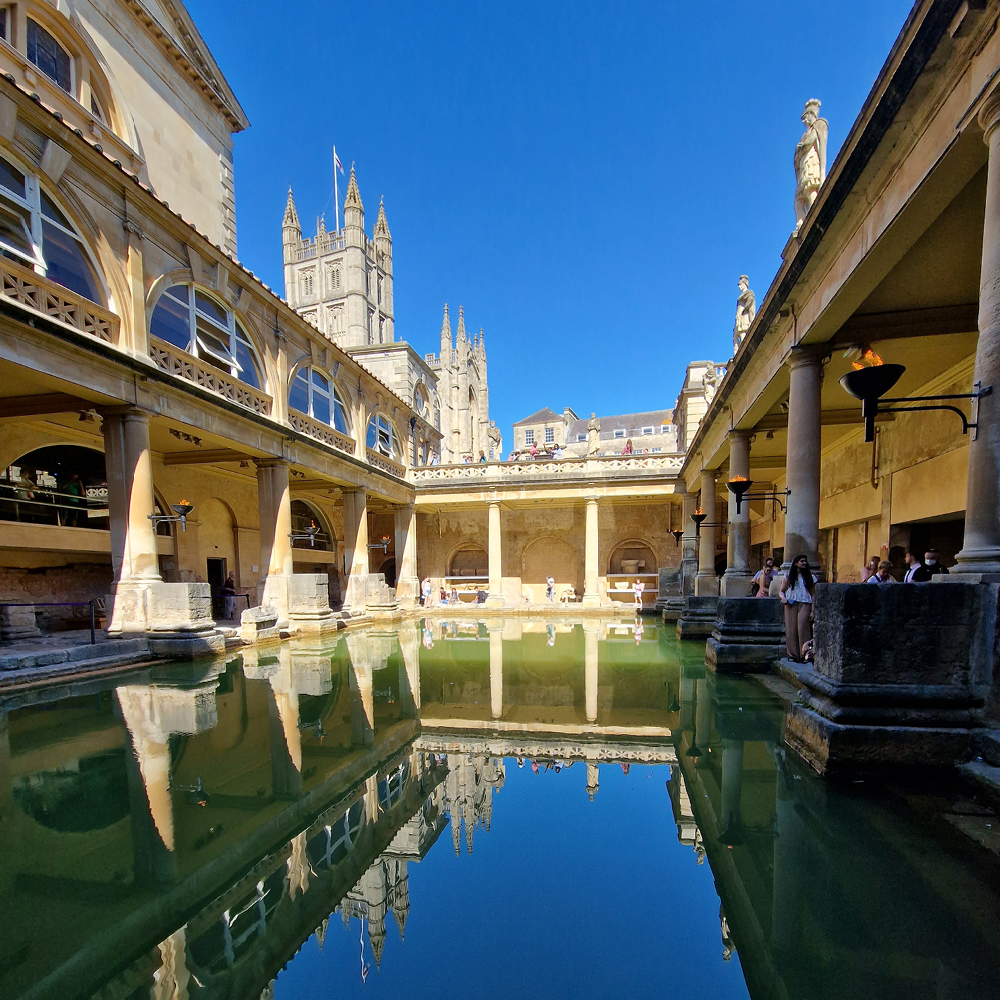
Visitors to the Roman Baths can experience sophisticated Roman engineering and the importance of Aquae Sulis (Roman Bath) as a religious and social centre nearly 2,000 years ago. The Great Bath, still filled with natural spring water, creates a connection to Roman Britain. Carved stones depict Celtic-Roman deities, and artefacts recovered from the sacred spring reveal details of religious practice, daily life, and cultural fusion between Roman and British traditions.
The scale of the baths surprises many visitors; this was a major religious complex with a temple, bathing facilities, and elaborate social spaces. The engineering required to manage hot water, create waterproof structures, and maintain heating systems demonstrates technical capabilities that medieval Britain couldn’t match for a thousand years after the Romans left.
3. Bath Is A Walkable City
Bath’s easy walkability delights visitors accustomed to sprawling cities that require constant transport. Many of the top major attractions in Bath sit within a comfortable walking distance. This wasn’t accidental, Bath was developed as a spa resort where wealthy visitors came to “take the waters” for health whilst socialising with their peers.
The city was designed for leisurely promenading, with streets connecting bathing facilities, assembly rooms, churches, shops, and residential crescents where visitors lodged during the season. Fashionable Georgian tourists spent their leisure time here, enjoying the healing waters’ restorative powers.
4. The Royal Crescent Defies Expectations
Terraced houses, 30 in total, arranged in a 500-foot curve, faced in Bath stone with ornate columns, is a sight enjoyed by many visitors to Bath. Built between 1767 and 1774, the Royal Crescent represented cutting-edge fashionable living with views across parkland, and was designed to impress residents and tourists alike.
What surprises many Best UK Tour visitors is that these are still private homes (except Number 1, which operates as a museum). The museum recreates Georgian townhouse life with period furnishings, and explains how wealthy Bath residents lived. The sweeping curve of honey-coloured stone against (hopefully) blue sky creates one of England’s most photographed streets.
5. Pulteney Bridge Shops
Bridges with shops built along them are rare; there are only 4 in the world. Florence’s Ponte Vecchio is the famous example, and Bath’s Pulteney Bridge is another. Completed in 1774, the bridge crosses the River Avon, connecting the city centre to external areas.
Many visitors walk across Pulteney Bridge without realising it’s a bridge (the shops hide the fact you’re crossing water) Visitors can browse small independent retailers in charming, even if slightly cramped, spaces, including;
- Jewellers
- Gift shops
- Boutiques
- Cafés
Strolling along the riverside path reveals the bridge’s three-arched structure and views of the shops on both sides of the river.
6. Bath Abbey’s Fan Vaulting
Bath Abbey’s Gothic fan demonstrates late Gothic English architecture at its most accomplished. It was installed in the early 16th century and is still as visually impressive today. Fan vaulting creates an extraordinary effect as its arches spread outwards and distribute weight from the roof across multiple points rather than straight down through columns.
Bath Abbey’s vaults create intricate patterns that reward looking upward for extended periods – until your neck complains! Concerts happen regularly in the abbey, taking advantage of the acoustic qualities created by the historic stone architecture and soaring spaces.
7. Stunning City Viewpoints
Bath’s valley setting means the surrounding hills offer magnificent views across the city, revealing the architecture and structures that street-level exploring doesn’t quite capture. From an elevated position, you can see how Georgian crescents and terraces bend, undulate, and follow the city’s topography.
Alexandra Park, Bathwick Fields, and Beechen Cliff all offer beautiful panoramas of Bath’s layout and demonstrate why UNESCO designated the entire city as a World Heritage site.
8. The Circus
The Circus creates a circular space surrounded by three curved terraces of townhouses, like the Royal Crescent but inverted. Where the Crescent curves outward, the Circus curves inward, creating an enclosed circular space.
It’s an ambitious piece of town planning. The Circus’s diameter is flanked by rows of columns matching those of Stonehenge’s outer circle (a reference that connects Bath to ancient British history). You can follow that thread on our full-day trip combining Stonehenge’s inner circle with the Roman Baths. From the centre, the uniform curve creates an almost disorienting experience; in every direction, the geometry looks similar, and the circular form feels both grand and artistic.
9. Thermae Bath Spa
Britain’s only natural thermal bathing springs are in Bath, allowing visitors to experience immersion in hot mineral water. The rooftop pool is open year-round and creates the surreal experience of bathing in warm water whilst overlooking Bath’s uniformly coloured streets and buildings.
It combines contemporary architecture and facilities that connect visitors to Bath’s 2,000-year bathing tradition. You’re doing what the Romans did; bathing in thermally heated water emerging from the same springs. But with modern amenities and considerably better hygiene standards! It’s therapeutic, relaxing, and pleasantly indulgent
10. The Georgian Architecture
What impresses many first-time visitors to Bath is the Georgian elegance that extends beyond the pretty facades of homes. Entire streets, crescents, and squares were meticulously planned, creating magnificent streetscapes and residential areas.
This style of planning was unusual for the 18th century, with uniform building heights, coordinated details, careful spacing, and deliberate sight lines. Its architecture was designed to impress visitors whilst providing upscale, comfortable living for wealthy Georgian society and making Bath the most fashionable English resort outside London.
Get in touch with Best UK Tours to plan your visit to Bath or to incorporate Bath into your multi-day trip to England.