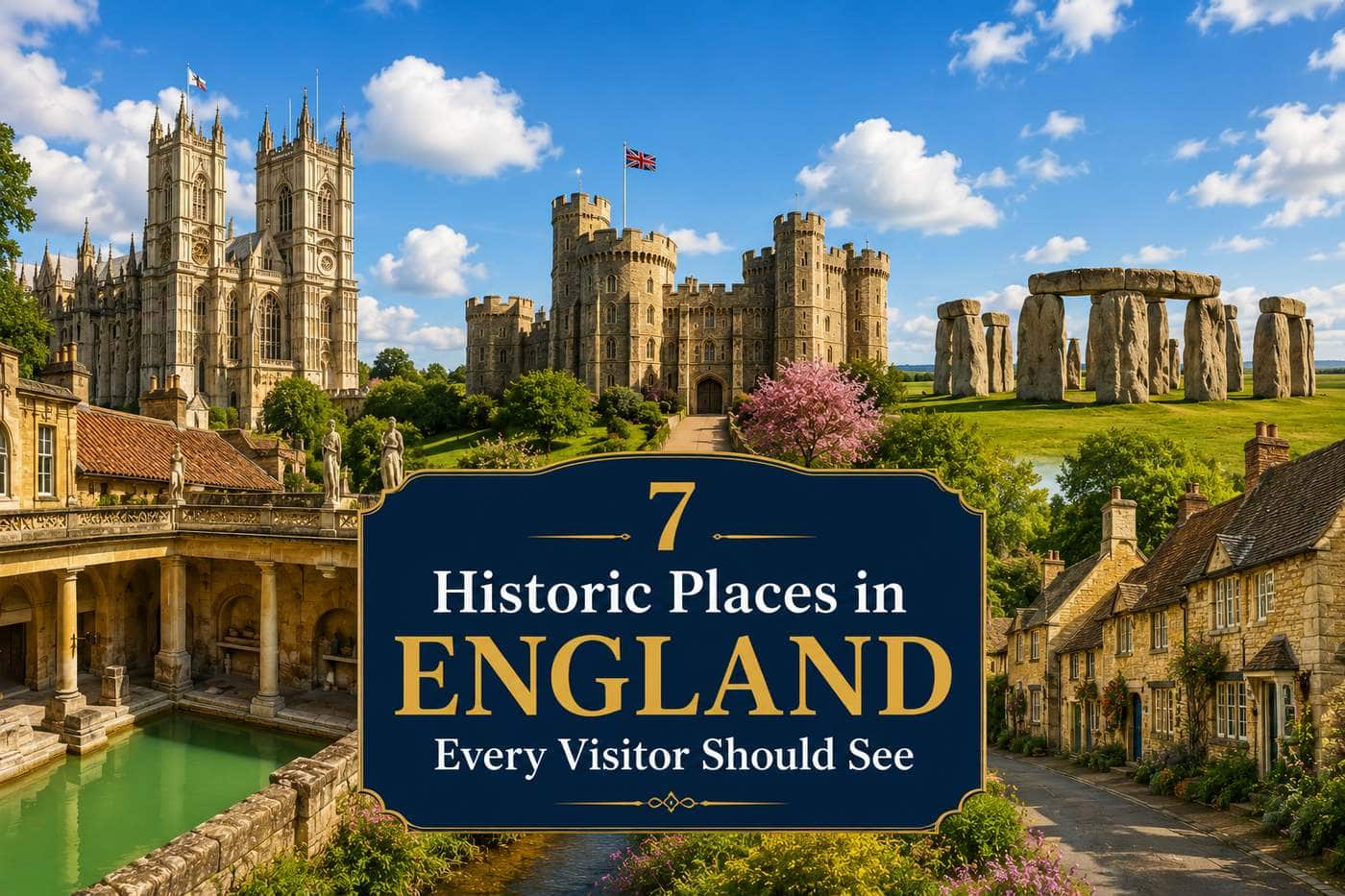
Iconic sites that showcase centuries of extraordinary history
England feels less like something you read about and more like something you walk through, around virtually every corner, down cobbled medieval alleys, across windswept hillsides, beneath vaulted cathedral ceiling;, there is evidence of a past that stretches back further than most countries can begin to imagine.
Best UK Tours offers bespoke and planned itineraries to help you discover England.
1. Stonehenge, Wiltshire
Stonehenge was constructed in several phases beginning around 3000 BC, making it over five thousand years old. To put that in perspective, it’s older than the Egyptian pyramids. The engineering required has baffled archaeologists and engineers for generations, and the monument’s astronomical alignment with the midsummer sunrise suggests a deep understanding of the sky and planetary motion.
A satisfying account of exactly why Stonehenge was built has yet to be produced. The surrounding landscape is a UNESCO World Heritage Site, with dozens of burial mounds, processional avenues, and prehistoric earthworks extending well beyond the familiar stone circle.
Many people decide to visit the Roman baths & Stonehenge in a day as they are only 1 hour away from each other
2. The Tower of London, London
Founded by William the Conqueror in 1066 following his victory at the Battle of Hastings, the Tower has served across the centuries as a royal palace, a treasury, a mint, a prison and a place of execution. Anne Boleyn, Lady Jane Grey, and Sir Walter Raleigh all spent time within its walls. The Crown Jewels, still in active use by the monarchy, are displayed in the Tower, and Yeoman Warders (known as Beefeaters) offer tours that deliver nine hundred years of intrigue, treachery, and royal excess. The Tower sits on the north bank of the Thames in central London, making it easy to combine with other city landmarks. With its royal connections and far-reaching history, it is one of England’s most visited attractions.
3. Hadrian’s Wall, Northumberland
Built on the orders of Emperor Hadrian beginning in AD 122, this structure once stretched eighty-four miles from the Solway Firth in the west to the River Tyne in the east, marking the northernmost frontier of the Roman Empire. It was a fully integrated military system with forts, watchtowers, and roads, designed to control movement and project Roman authority across the north of the country. The central section of the wall runs through Northumberland National Park along a dramatic dolerite ridge known as the Whin Sill and offers some of the finest walking in northern England. The forts at Housesteads and Vindolanda display excavations and artefacts that reveal the daily lives of Roman soldiers stationed there, including handwritten letters, boots, and tools.
4. York (Britain’s own Diagon Alley)
York offers visitors an enormous amount to see in a relatively compact area, and almost all of it offers outstanding history. The city’s centrepiece is York Minster, one of the great Gothic cathedrals of northern Europe, built over two and a half centuries and completed in 1472. Its medieval stained glass windows are among the finest and most extensive anywhere in the world, and the sheer scale of the building is impressive.
Excavations beneath it have revealed remnants of a Roman fortress that predates the medieval city by over a thousand years. York’s medieval street plan includes the famous Shambles (reminiscent of Diagon Alley in the Harry Potter films); a narrow, timber-framed lane that was once the city’s butchers’ quarter. It is one of the best-preserved medieval streets in Europe, with upper storeys leaning so far inward that they almost touch overhead. The Roman city walls, rebuilt by the Normans, can be walked for almost their full length and offer dramatic, elevated views across the city.
5. Bath, Somerset
Bath is a living, functioning city and a UNESCO World Heritage Site. Romans discovered the naturally hot mineral springs there and built a bath complex around them in the first century AD. The Roman Baths are still very well-preserved, with original flooring, lead-lined pools, and a sophisticated heating system. The Pump Room offers an experience you can only find in Bath: a Georgian tearoom serving afternoon tea on the site of a two-thousand-year-old spa. The city’s Georgian architecture, featuring the Royal Crescent, the Circus, and Pulteney Bridge, forms a second, separate layer of history built largely in the eighteenth century. The author Jane Austen lived here for several years when Bath was the most fashionable place to be in England.
6. Canterbury, Kent
When four knights entered the cathedral and murdered Archbishop Thomas Becket in 1170, it ensured that Canterbury forever had a place in English history. The site of Becket’s murder is marked and draws visitors from around the world. It became one of the most important pilgrimage destinations in Christian Europe; a status it held for centuries and immortalised in Chaucer’s Canterbury Tales. Canterbury Cathedral remains the seat of the Archbishop of Canterbury, and its medieval architecture is outstanding, spanning centuries of construction and featuring an excellent example of Perpendicular Gothic vaulting. The city surrounding the cathedral is well worth exploring, with its ancient city walls, medieval streetscapes, and independent shops and restaurants that make Canterbury an excellent place to spend a day.
7. Blenheim Palace, Oxfordshire
Built in the early eighteenth century as a gift to John Churchill, following his victory at the Battle of Blenheim in 1704, Blenheim Palace is one of the largest private residences in Britain and a UNESCO World Heritage Site. The palace is the birthplace of Sir Winston Churchill and houses a permanent exhibition that traces his life from childhood to wartime leadership. Visitors can view the grand state rooms and formal apartments, as well as the grounds, which are an attraction in their own right. Landscaped by Capability Brown in the 1760s, they feature a vast park of lakes, formal gardens, and open parkland. Blenheim is located in Oxfordshire, easily reachable from Oxford and is well worth combining with a visit to the city of dreaming spires.
See England’s History With Best UK Tours
History is best experienced in person, and England has more of it than almost anywhere else on earth. These sites represent just a portion of England’s extraordinary heritage, with Roman history, medieval architecture, and royal palaces. Alongside the monuments sit the everyday English things worth planning a visit around, which we have gathered in our guide to classic English experiences every visitor should try. Explore our range of Multi-day UK tours, or get in touch to discuss a Bespoke England tour with our expert guides.
Get in touch today to discuss a Bespoke England tour with our expert guides, or explore our range of Multi-day UK tours.