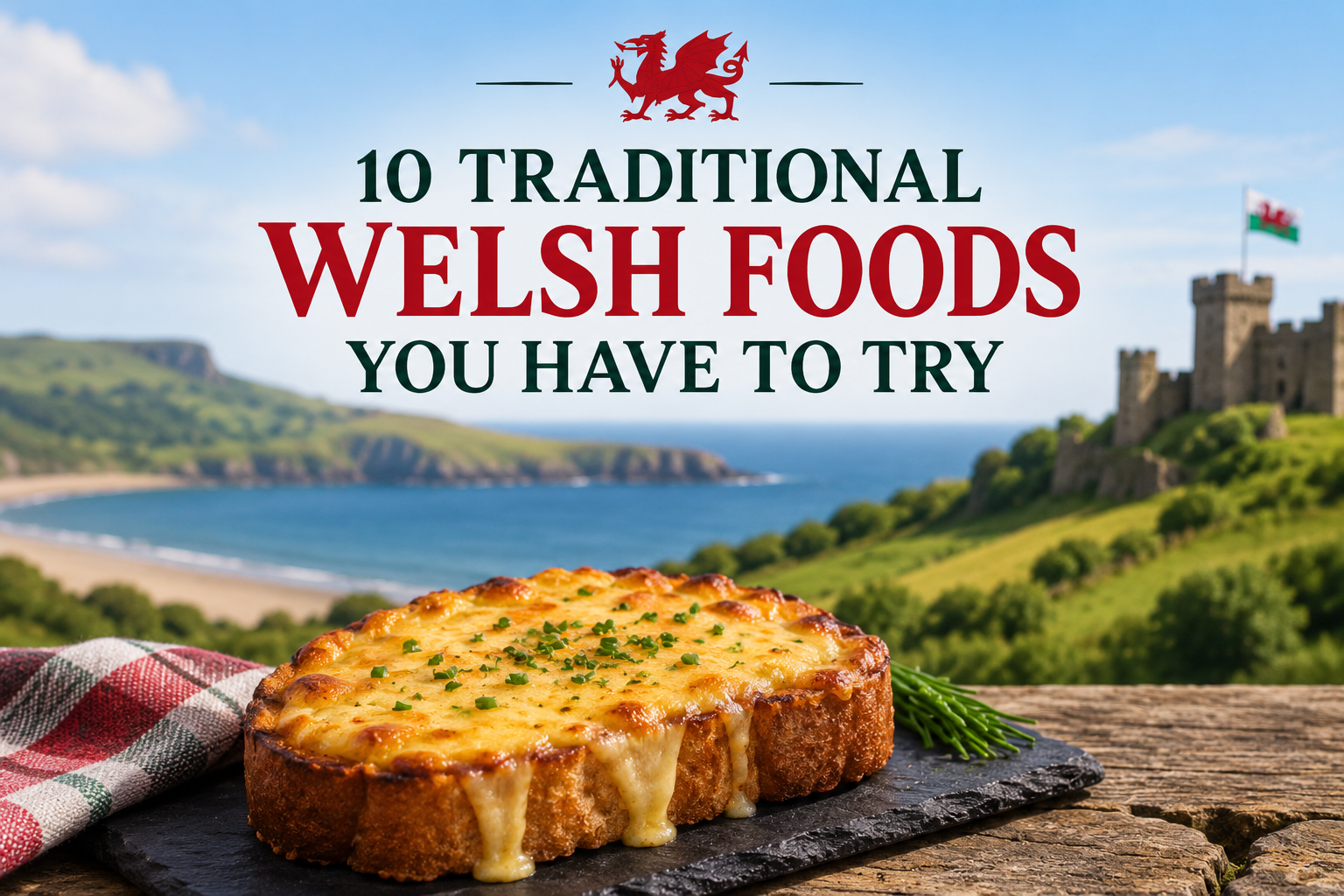
From Welsh cakes to bara brith, here’s Best UK Tours’ foodie’s guide to the very best of traditional Welsh foods and Welsh cuisine
If you’re planning a visit to Wales through Best UK Tours or want to eat your way through the country with purpose, here are ten traditional Welsh foods that deserve a place on your plate.
1. Cawl
This slow-cooked broth of lamb and root vegetables, with leeks, carrots, swede, and potatoes, has been warming Welsh households since the 14th century. Every family has their own recipe, every version tastes marginally different, and everyone’s grandmother made the best one. Served with hunks of crusty bread and a block of Caerphilly cheese on the side, cawl is less a dish and more a warm embrace in edible form. Do not leave Wales without trying it.
2. Welsh Cakes (Pice ar y Maen)
Welsh cakes are small, round, lightly spiced griddle cakes studded with dried fruit and dusted with caster sugar. The Welsh name, pice ar y maen, translates as “cakes on the stone,” a nod to the traditional bakestone on which they were cooked. Somewhere between a scone and a biscuit in texture, they are best eaten warm, straight from the griddle, with a proper cup of tea. You will find them in virtually every bakery, market stall, and cafés across the country.
3. Bara Brith
Bara brith translates from Welsh as “speckled bread,” which is a fruit-packed tea loaf. Dried mixed fruit is soaked overnight in cold black tea, then combined with flour, egg, and mixed spice before being baked into a dense, moist loaf. It is traditionally sliced thickly and spread with salted Welsh butter, and it is one of those things that taste better than you expect, which makes it all the more enjoyable. A staple of farmhouse kitchens for generations, bara brith remains a fixture on café counters throughout Wales to this day.
4. Welsh Rarebit
Despite concerns, Welsh rarebit contains no rabbit, and never did. It is a gloriously rich sauce of melted cheese (often sharp Welsh cheddar) combined with ale, mustard, and Worcestershire sauce, poured generously over thick slices of toasted bread. To the uninitiated, it might sound like dressed-up cheese on toast. Still, in Welsh kitchens, it is an entirely different dish: savoury, complex, satisfying, and far more impressive than its humble origins suggest.
5. Laverbread (Bara Lawr)
Made from cooked and puréed laver, a type of edible seaweed harvested along the Welsh coastline. Laverbread is dark, intensely savoury, and tastes bracingly of the sea. It is most commonly served as part of a traditional Welsh breakfast, alongside bacon, cockles, and eggs, and is sometimes rolled in oatmeal and pan-fried into crisp little patties. It has been part of Welsh coastal cooking for centuries, and those who embrace it rarely look back.
6. Cockles (Cocos)
Wales has a tradition of cockle harvesting, particularly around the Gower Peninsula, where small boats have worked the cockle beds for generations. Fresh cockles are briny and sweet; a world away from the vinegary, jar-preserved variety that appears on chip shop counters. In Wales, you might find them served simply with laverbread and bacon on a breakfast plate, tossed through buttered pasta in a more contemporary setting, or sold fresh from a market stall, which is very much the right way to eat them.
7. Glamorgan Sausage
Wales’ famous Glamorgan sausage managed to beat the modern vegetarian movement by a few centuries. Made from Caerphilly cheese, leeks, breadcrumbs, and mustard, then formed into cylinders and pan-fried until golden, they are crisp on the outside, molten and fragrant within, and absolutely delicious. Named after the historic county of Glamorganshire in South Wales, they were traditionally a way of making good use of cheese and leeks, and they often appear as a starter in many Welsh restaurants.
8. Caerphilly Cheese
Caerphilly is one of Britain’s oldest and most distinctive regional cheeses, originating in the market town of the same name just north of Cardiff. It is pale, crumbly, and moist, with a clean, milky flavour and a faint tang that becomes more pronounced with age. Historically, it was a staple food for coal miners in the South Wales valleys, providing a compact, calorie-dense source of energy during long working shifts. Today it appears on cheese boards, in rarebit, inside Glamorgan sausages, and alongside a bowl of cawl. If you visit a Welsh farmers’ market, seek out an artisan-produced Caerphilly – it’s delicious!
9. Crempog
Wales has its own take on the pancake, and crempog (also known as ffroes in some parts of the country) are thicker and fluffier than the thin French crêpe, made with buttermilk and a touch of vinegar that gives them a subtle tang. They are traditionally served in a warm stack, layered with salted butter, and finished with honey or treacle. Crempog occupies a warm and comforting corner of Welsh baking tradition, appearing on tables at family gatherings, village fetes, and cosy farmhouse kitchens on cold mornings.
10. Welsh Lamb
Welsh lamb is the finest single ingredient the country produces. Raised on upland pasture and, in many coastal areas, on salt marshes that give the meat its distinctive mineral sweetness, Welsh lamb has been awarded Protected Geographical Indication (PGI) status, recognition that its quality is directly tied to Wales. Roasted simply with rosemary and garlic, slow-cooked in a cawl, or served as a chop straight from the grill, it is outstanding. Any restaurant in Wales worth visiting will feature it prominently on the menu.
Taste Wales With Best UK Tours
The best way to experience Welsh food isn’t through a list — it’s by getting there and eating the real thing. Best UK Tours offers private, bespoke tours of Wales tailored to your interests, including its food, culture, and landscapes. Explore Conwy’s medieval streets, the dramatic scenery of Snowdonia, or the vibrant food scene of Cardiff with a private guided tour.
Explore our full range of Wales tours or get in touch to discuss a bespoke Welsh itinerary built entirely around you.