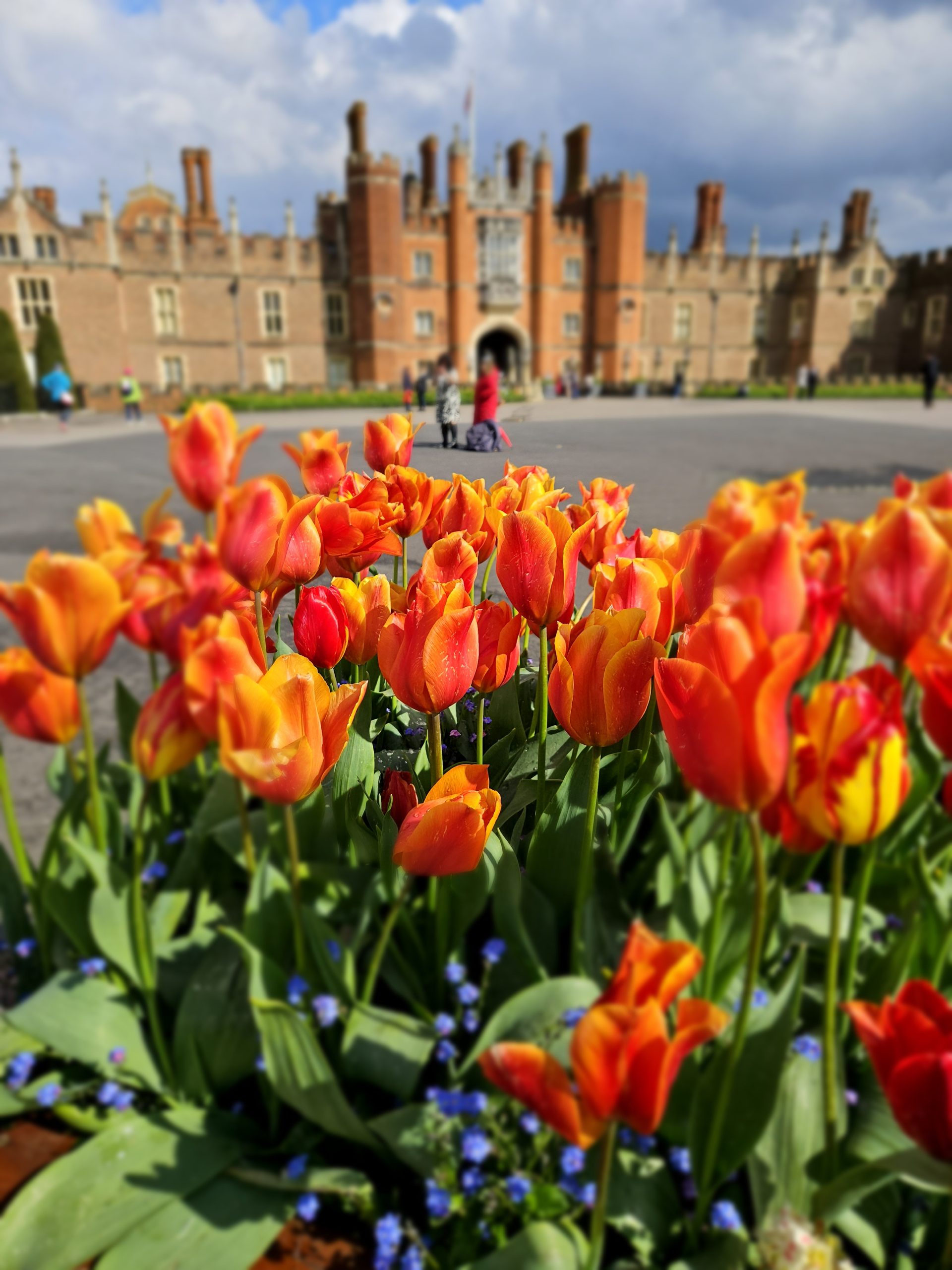
Hampton Court Palace is steeped in stories that bring history vividly to life and captures a time when England’s most notorious king, Henry VIII, lived large and left consequences that are still being discussed 500 years later.
After years of touring Hampton Court Best UK Tours has gathered stories that offer a fascinating glimpse into Tudor ambition, paranoia, and royal life.
1. Who Built Hampton Court?
Hampton Court originally belonged to Cardinal Thomas Wolsey, (Henry’s chief minister). Wolsey spent money lavishly, creating a palace grand enough to host the king and visiting ambassadors. It was a move to demonstrate his wealth and importance, but King Henry VIII rather liked the grand structure and began to covet it.
When Wolsey failed to secure papal approval for Henry’s divorce from Catherine of Aragon, his position collapsed. Desperately trying to regain royal favour, Wolsey “gifted” Hampton Court to Henry, but the gesture didn’t save him. Wolsey died in 1530, stripped of power and wealth and Henry spent the next fifteen years expanding and improving Hampton Court.
2. Where Is Hampton Court Located?
Hampton Court Palace sits in Richmond upon Thames, approximately 12 miles from central London and is easily accessible by train, or boat along the Thames during summer months. Combining Hampton Court with nearby attractions like Windsor Castle or the historic city of Bath creates exploration that feels distinctly different from London’s busy urban core.
The palace hosts various events throughout the year, that enhance standard visit such as:
- Tudor cooking demonstrations
- Garden festivals
- Christmas decorations
3. What Is The Hammer-Beam Roof?
Hampton Court’s Great Hall features one of the finest hammer-beam roofs in England, a medieval engineering technique that creates vast open spaces without the need for central supporting pillars. The roof spans 106 feet, rising 60 feet above the floor, decorated with carved pendants, heraldic beasts, and Henry’s personal symbols.
Completed in 1535, this roof represented cutting-edge Tudor craftsmanship combined with deliberate medieval revivalism. Henry preferred Gothic grandeur that connected him to England’s medieval kings whilst demonstrating his wealth and power.
4. How Big Are The Kitchens?
Hampton Court’s Tudor kitchens are amongst the largest and best-preserved in Europe, comprising over 50 rooms designed to feed Henry’s enormous court. These were industrial-scale food production facilities requiring armies of servants working in specialised departments.
The cellars held three years’ worth of wine at any given time (over 300,000 litres) because Henry VIII was nothing if not prepared for entertaining. Visiting the kitchens today provides an insight into the labour and organisation required to maintain royal court life.
5. Does The Astronomical Clock Still Work?
The astronomical clock in Clock Court, installed in 1540 shows the hour, date, month, star sign, phases of the moon, and the time of high water at London Bridge. This was crucial information when the Thames served as the main transport route.
It’s astronomically incorrect by modern standards but mechanically impressive and beautifully crafted. The clock still functions today, nearly 500 years later, requiring only routine maintenance.
6. Does Catherine Howard’s Ghost Roam The Halls?
Catherine Howard, Henry’s fifth wife, was arrested at Hampton Court in November 1541, accused of adultery. According to legend, she broke free from guards and ran through what’s now called the Haunted Gallery, screaming for mercy. Four months later, was executed at the Tower of London.
Whether this scene actually occurred is historically uncertain, but the Haunted Gallery’s reputation persists, with visitors and staff reporting unexplained sounds, sudden temperature drops, and occasional sightings of a distressed young woman in Tudor dress.
7. Does It Have A Tudor Tennis Court?
Hampton Court contains one of the world’s oldest surviving real tennis courts, built for Henry VIII around 1530 and still used for matches today. Real tennis (also called royal tennis) differs from modern lawn tennis, and is played indoors on an asymmetric court with complex rules.
The court underwent restoration in the 1620s under Charles I, but its Tudor origins remain. Watching a real tennis match here connects you directly to Tudor sporting culture, this is what Henry VIII did for recreation, in this exact space, 500 years ago.
8. Did William III Transform Hampton Court?
After Henry VIII’s death, Hampton Court remained a royal residence through various monarchs, but its next major transformation came with William III and Mary II in the 1690s. They hired Christopher Wren (the architect of St Paul’s Cathedral) to rebuild sections in contemporary Baroque style, creating the palace’s curious split personality between Tudor and Stuart architecture.
These rooms demonstrate how different eras expressed royal power through completely different architectural languages with a layering that makes Hampton Court architecturally fascinating.
- How Old Is The Maze?
Hampton Court’s maze dates from William III’s reign around 1700, with significant Victorian expansion and replanting. The design is deceptively simple, a series of paths around a central area, but it’s difficult to solve without assistance.
The maze covers roughly a third of an acre planted with hornbeam hedges maintained at about seven feet tall. The maze isn’t enormous, but the effect of identical-looking corridors can create some disorientation. Experiencing the maze has been part of visiting the palace for over three centuries, creating its own tradition.
10. Do The Gardens Reflect Hampton Court’s Changing Eras?
Hampton Court’s 60 acres of formal gardens showcase evolving garden design from Tudor times through contemporary plantings. The Pond Garden recreates Tudor knot gardens, The Privy Garden demonstrates Baroque formality, and The Great Vine, planted in 1768, still produces grapes annually.
The gardens and palace grounds represent layers of different periods. Tudor gardens emphasised symmetry, heraldry, and enclosed spaces. William III preferred Continental grandeur with fountains, statues, and vistas. Victorian plantings added colour and exotic species from the expanding British Empire.
11. How Vast Is Hampton Court?
Hampton Court covers 1,300 rooms across six acres of buildings, courtyards, and passageways. The public route covers perhaps ten percent of this, but even the accessible sections create genuine disorientation if you’re not paying attention to signage.
Tudor palaces were deliberately complex, with different routes for different ranks of courtiers, private passages, and service areas. Status determined which doors you could use, which staircases you could climb, and how close to the king’s private apartments you could venture.
12. How Historically Important Was Hampton Court?
Walking through the rooms and courtyards of Hampton Court with Best UK Tours connects you directly to history in ways that books and documentaries can’t.
These are the spaces where Henry VIII entertained important noblemen, where wives walked in fear, where decisions affecting English history were made. Royal court life played out with intrigue and danger. The palace witnessed births, deaths, marriages, arrests, celebrations, and endless political manoeuvring.
Best UK Tours provide expert guidance that brings these magnificent buildings to life. Contact us to book your Hampton Court tour today.